

Texas Trial Courts Do Not Automatically Record Hearings—But They Should

Updated: Dec 17, 2025

I'm a Texas attorney. I'm currently litigating a mandamus petition before the Texas Supreme Court that raises a question I never expected to face: what happens when a trial court holds a contested evidentiary hearing, issues a written order stating the testimony was "duly reported" by a certified court reporter—and then you discover no record was ever made?
The Setup
On June 25, 2025, I appeared for a contested hearing in my own divorce case in the 312th District Court of Harris County.
A certified court reporter was physically present in the courtroom, seated with her equipment. Texas law requires court reporters to record contested evidentiary proceedings, and the reporter was right there. I therefore assumed the hearing was being recorded.
The hearing concluded. The trial court issued restrictive temporary injunctions over my objection, without my ex-husband even having to state a cause for their issuance. My attempts to speak were interrupted.
And the written order explicitly stated that "The record of testimony was duly reported by Ramona Gonzalez, Court Reporter for the 312th Judicial District Court, Harris County, Texas."
Except it wasn't.
When I requested the transcript, I learned that no recording equipment had been activated. No stenographic record had been made. The truth is the record of what had transpired at the hearing had never existed.
The Structural Problem
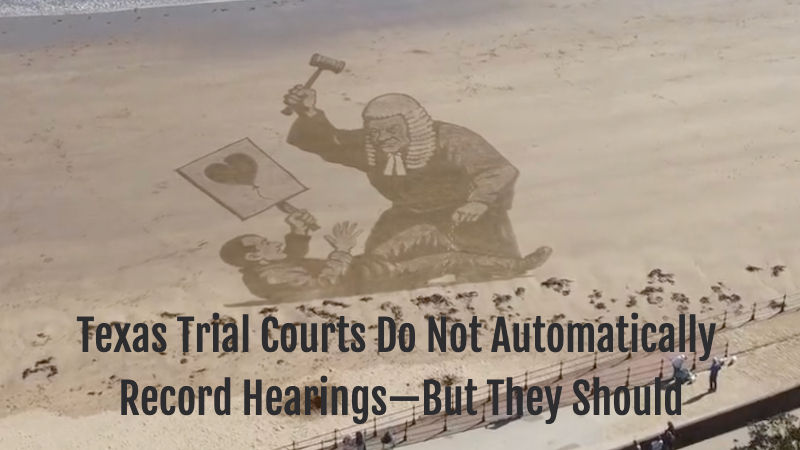
Here's what keeps me up at night about this situation: the absence of a record creates a perfect asymmetry of consequences.
When there's no record, the trial court's rulings become effectively insulated from meaningful appellate review. Counsel's conduct—whether compliant with professional standards or not—can't be evaluated. But the litigant? The litigant loses the ability to demonstrate error, preserve issues, or seek redress.
Every participant in the proceeding is protected by the missing record except the person whose rights are being adjudicated.
The Mandamus Path
After the Fourteenth Court of Appeals declined relief, I filed a petition with the Texas Supreme Court. The petition raises what I believe are questions of first impression: What are the constitutional due process implications when a trial court conducts a contested evidentiary hearing without creating any record, while simultaneously issuing a written order falsely certifying that testimony was "duly reported"?
I've requested oral argument because this isn't just about my case. It's about court reporting practices statewide and litigants' fundamental right to appellate review.
Likely Outcome
Odds are the Texas Supreme Court will deny my petition. Most mandamus petitions are denied, and I am self-represented. Though every U.S. citizen has a Constitutional right to self-representation, most courts have an unveiled bias against pro se litigants - even if they are attorneys.
Regardless, I see this as an great exercise and opportunity to education both myself and the general public to approach the civil "justice" system with a healthy dose of skepticism. Legal justice is not the only factor playing into a judge's decisions. I've thought to myself that the civil courthouse is like an attorney employment agency. Many judges and attorneys are not slow to admit their desire to keep legal knowledge out of the hands of the general public. But I myself want right answers from the justice system, not job security. I want to be on the right side of history, not my balance sheet.
It has cost me money to fight these losing battles, but it has been worth every penny to have the opportunity to either work with a fair and common sense judiciary to improve our justice system or, in the alternative, to give our justice system an opportunity to show itself for what it is in 2025. I'm auditing the system to see how far we've come toward a majority of powerful people truly desiring to democratize justice.
What I've Learned
If you're a pro se litigant, here's what I'd tell you: never assume you're on the record. Even when a court reporter is physically present. Even if a proposed order says a record will be made. Even when state law orders courts to automatically record. Because the consequences for there being no record fall solely on you.
Confirm on the record at the start of every hearing that the recording is active. Ask the court reporter directly.
I'll update this space as the mandamus proceeds. For now, the petition is pending, and I'm waiting to see whether the Supreme Court will take up a question that affects every litigant who walks into a Texas courtroom expecting their day in court to be preserved for review.

Comments