

Ten Classics to Add to Your Reading List

Updated: Dec 30, 2025
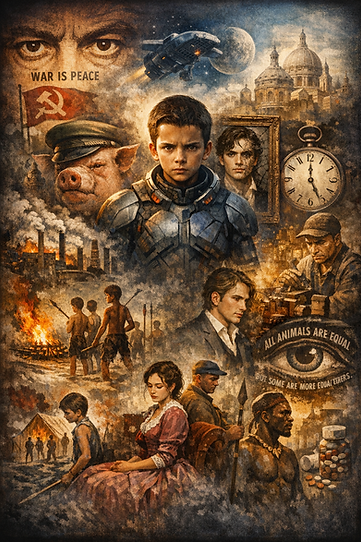
Some books entertain. Others educate. A rare few interrogate the reader—and refuse to let them look away.
The following ten works span centuries, continents, and genres, but they share one trait: each forces the reader to reckon with human nature as it actually is, not as we wish it to be. They don’t just tell stories; they ask uncomfortable questions about power, morality, identity, desire, and the fragile structures we call civilization. These are not comforting books, and that’s precisely their merit.
1. Ender’s Game
Orson Scott Card
Often mislabeled as simple science fiction, Ender’s Game is a brutal ethical thought experiment. It explores whether innocence can survive utility, whether empathy can coexist with command, and whether winning at all costs is a moral failure or a tragic necessity.
What makes the novel endure is its refusal to give the reader moral relief. Ender’s brilliance is inseparable from his exploitation. The adults who “protect” humanity do so by destroying a child’s soul—and convincing themselves it was unavoidable. The book lingers because it asks a question modern societies still avoid: what happens when our survival depends on turning children into weapons?
2. Lord of the Flies
William Golding
This novel is often taught as a lesson about savagery, but its deeper power lies in its critique of moral laziness. Civilization does not collapse because rules disappear; it collapses because people choose power, fear, and tribalism over responsibility.
Golding strips away adult authority and reveals something chilling: evil does not require ideology or trauma—it requires permission. Lord of the Flies endures because it dismantles the myth that humans are naturally good and corrupted only by institutions. Sometimes, institutions are the thin line holding us together.
3. The Picture of Dorian Gray
Oscar Wilde
This is not merely a story about vanity; it is a study of moral outsourcing. Dorian attempts to separate pleasure from consequence, beauty from responsibility, desire from accountability—and pays for it with the slow annihilation of his soul.
Wilde’s brilliance lies in his refusal to moralize overtly. Instead, he seduces the reader alongside Dorian. The horror creeps in quietly, as we realize the price of a life lived entirely for aesthetic pleasure is not scandal—but emptiness.
4. Animal Farm
George Orwell
Few books expose political betrayal with such ruthless efficiency. Animal Farm shows how revolutions rot—not because ideals are flawed, but because power attracts those willing to manipulate language, memory, and fear.
Its lasting relevance comes from its insight into propaganda: whoever controls the story controls reality. The tragedy isn’t just that the animals are oppressed again—it’s that they’re taught to forget they ever wanted freedom in the first place.
5. Brave New World
Aldous Huxley
If 1984 warns against oppression through force, Brave New World warns against oppression through pleasure. Huxley understood something modern societies still resist admitting: people will surrender freedom voluntarily if comfort, entertainment, and sexual gratification are abundant enough.
The novel’s brilliance lies in its quiet terror. No one is tortured. No one rebels meaningfully. That’s the point. A society that anesthetizes discomfort also anesthetizes conscience.
6. 1984
George Orwell
This is not just a political novel; it is a psychological one. Orwell demonstrates how totalitarianism does not merely control behavior—it colonizes thought, language, memory, and even love.
What keeps 1984 urgent is its understanding that truth is fragile. Once language collapses, resistance becomes unthinkable. The most frightening line in the novel is not about Big Brother—it’s about learning to deny what your own eyes see.
7. Madame Bovary
Gustave Flaubert
Emma Bovary is not foolish—she is romantically educated by lies. This novel dissects the danger of consuming fantasies without discernment, especially for women taught to believe fulfillment comes from passion, luxury, or escape.
Flaubert’s genius is his refusal to rescue Emma or condemn her outright. He exposes the emotional cost of self-deception and the quiet violence of boredom, unmet longing, and social constraint. It is a devastating portrait of desire without grounding.
8. Great Expectations
Charles Dickens
At its heart, this is a novel about shame—class shame, moral shame, and the slow recognition that self-worth cannot be purchased or inherited.
Pip’s “great expectations” are a trap. The more he ascends socially, the more he loses his moral clarity. Dickens reminds us that aspiration without virtue produces emptiness, and that true gentility is revealed not by status, but by loyalty, humility, and conscience.
9. The Jungle
Upton Sinclair
This book is often remembered for its impact on food safety laws, but its deeper power lies in its exposure of economic cruelty. The Jungle shows how systems grind people down not through individual malice, but through indifference.
Sinclair forces readers to confront the human cost of unchecked capitalism: bodies broken, families destroyed, dignity stripped away. It remains relevant because exploitation evolves faster than reform—and because outrage fades quickly without vigilance.
10. Things Fall Apart
Chinua Achebe
Achebe accomplishes something rare: he tells a story of colonial disruption without flattening either side into caricature. The tragedy of Okonkwo is not simply colonialism—it is rigidity, pride, and an inability to adapt when the world changes.
The novel’s enduring strength is its moral complexity. Traditions can be meaningful and destructive. Change can be necessary and devastating. Achebe refuses simple villains, reminding us that civilizations often collapse not from invasion alone, but from internal fractures.
Why These Books Belong Together
Taken as a whole, these works form a moral education. They challenge fantasies—about progress, power, romance, innocence, pleasure, and control. They insist that human nature matters, that systems shape souls, and that ignoring reality has consequences.
These books endure because they do not flatter the reader. They demand discernment, humility, and courage. In an age of distraction and ideological shortcuts, their greatest merit may be this: they teach us how to think—and how to tell the truth, even when it costs us comfort.
Comments